Presidential Legacy
Eight years of transformative governance that reshaped Ghana and elevated Africa — 7 January 2001 to 7 January 2009.
 Democratic Governance
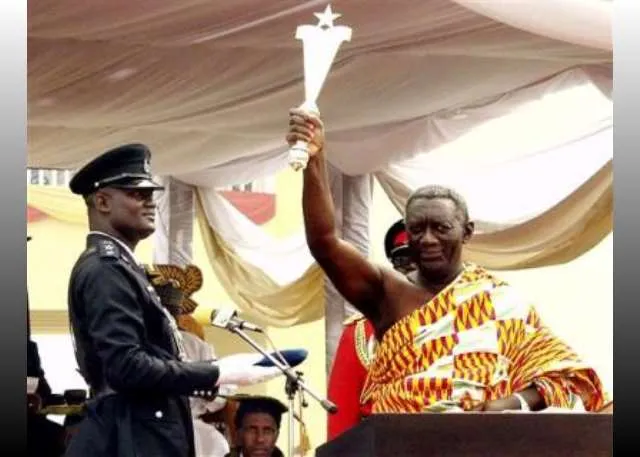
Democratic Consolidation & Rule of Law
President Kufuor's most enduring contribution to Ghana was not any single policy but his profound commitment to democratic institutions and constitutional norms. He governed with an absolute respect for the separation of powers — never attempting to manipulate the judiciary, the legislature, or the Electoral Commission — and actively strengthened each institution's independence during his tenure.
Press freedom flourished under his watch. The number of private FM radio stations grew from a handful to over 150; a vibrant independent press held his own government to account without fear of reprisal. Ghana consistently ranked among the top performers on continental press freedom indices throughout his presidency — a deliberate choice that reflected his deep conviction that accountability requires an active, independent media.
First peaceful inter-party transfer of power in Ghana's history — December 2000 elections.
Strengthened independence of the Electoral Commission, judiciary, and Parliament.
Dramatic expansion of private media: FM radio stations, newspapers, and online news platforms.
Ghana joined the African Peer Review Mechanism (APRM) voluntarily in 2003 — among the first in Africa.
Conducted a second peaceful democratic handover to opposition NDC in January 2009.
Ghana became a recognised model for democratic governance across the African continent.
"Ghana does not belong to any political party. Ghana belongs to all of us — the living, the dead, and those yet to be born."— H.E. John Agyekum Kufuor, Farewell Address, 7 January 2009
 Economic Transformation
Macroeconomic Stabilisation & Growth
The economy that President Kufuor inherited in January 2001 was in severe distress: inflation stood above 40%, external debt was unsustainable, foreign exchange reserves were critically depleted, and investor confidence had collapsed. The administration's early engagement with the HIPC debt-relief process — a difficult but courageous decision — laid the groundwork for the sustained economic recovery that followed.
The HIPC completion in 2004 unlocked significant debt relief and signalled to the international community that Ghana was a credible, well-managed economy. Combined with disciplined monetary policy and fiscal consolidation, this drove inflation from above 40% in 2001 to below 10% by 2008. GDP growth averaged 6% per annum throughout the Kufuor years — among the highest in sub-Saharan Africa.
The telecommunications liberalisation of this period was particularly transformative. Competition in the mobile sector drove subscriber numbers from under 250,000 in 2001 to over 12 million by 2009 — enabling mobile banking, agricultural market information services, and digital economic participation for millions of previously excluded citizens.
HIPC Completion (2004): significant debt relief secured; fiscal space created for social investment.
Inflation: reduced from above 40% (2001) to below 10% (2008).
GDP growth: sustained average of 6% per annum across eight years.
Mobile subscribers: 250,000 (2001) to over 12 million (2009) — digital revolution enabled.
Millennium Challenge Compact: $547 million agreement with the United States (2006).
Oil discovery governance: transparent frameworks established ahead of commercial production.
 Healthcare Revolution
The National Health Insurance Scheme
Of all the social programmes of the Kufuor presidency, none has had a more profound or lasting impact on the lives of ordinary Ghanaians than the National Health Insurance Scheme (NHIS), established by the National Health Insurance Act (Act 650) of 2003.
Before the NHIS, Ghana's health system operated on a brutal "cash-and-carry" basis: patients paid for every consultation, every medicine, every procedure at the point of use. For the majority of Ghanaians — especially in rural areas, for pregnant women, for children, and for the elderly — this meant going without care when they could not pay. The poor died from preventable conditions because they could not afford the cash required.
The NHIS changed this fundamentally. By the end of President Kufuor's second term, the scheme had enrolled over 11 million Ghanaians. Pregnant women and children under five received completely free coverage. Maternal mortality fell; infant mortality fell; utilisation of health facilities in rural areas increased dramatically. The NHIS is now widely studied across sub-Saharan Africa as a model for achieving universal health coverage in low and middle-income settings.
NHIS enacted 2003 — replaces the "cash-and-carry" system that excluded the poorest Ghanaians.
11 million+ Ghanaians enrolled by January 2009.
Pregnant women and children under five: fully free coverage.
Dramatic increase in rural health facility utilisation across all regions.
Reduction in maternal and infant mortality rates over the two presidential terms.
Studied as a continental model for universal health coverage by WHO and the African Development Bank.
 Education Reform
Education, School Feeding & Youth
President Kufuor's education reforms were driven by a simple conviction: that no Ghanaian child should be denied schooling because their family could not afford fees. The Capitation Grant of 2004 — abolishing fees at the basic education level for all public schools — was the single most direct intervention in this direction. Within two years of its introduction, primary school enrolment had increased by over one million pupils.
The National School Feeding Programme, launched in 2005, addressed both the nutrition crisis among school-age children and the attendance and retention problem in deprived communities. By providing one daily hot meal to pupils in participating schools, it dramatically improved attendance rates — particularly among girls — and reduced dropout. At its peak under his presidency, the programme was reaching 1.2 million children every school day.
These two programmes together were recognised by the World Food Prize committee in 2011, when President Kufuor was awarded the prize specifically for his contributions to reducing child hunger and improving education access in Ghana.
Capitation Grant (2004): school fees abolished at basic education level — enrolment up 1 million+.
National School Feeding Programme (2005): 1.2 million children fed daily.
Thousands of new classrooms and school buildings constructed across all regions.
GETFund expanded to finance educational infrastructure in deprived communities.
Dramatic improvement in girls' school attendance and retention in the Northern Region.
World Food Prize awarded 2011 specifically recognising the school feeding contribution.
 Infrastructure
Roads, Energy & Connectivity
President Kufuor oversaw the most ambitious infrastructure programme Ghana had seen in decades. Over 8,000 kilometres of roads were rehabilitated during his two terms — from the major arterial highway linking Accra and Kumasi to thousands of kilometres of rural feeder roads connecting farming communities to markets and services for the first time. The economic impact of improved road connectivity — in reduced post-harvest losses, in market access for smallholder farmers, in reduced transport costs for businesses — was enormous.
Ghana's electricity access rate increased from approximately 45% of the population in 2001 to 60% by 2009, driven by the National Electrification Scheme's systematic expansion into rural communities. Water and sanitation infrastructure received significant investment, particularly in the three northern regions, where access to safe water had lagged far behind the south.
8,000+ kilometres of roads rehabilitated, including major inter-city arteries.
Electricity access: 45% → 60% of population through rural electrification expansion.
Water and sanitation infrastructure expanded, particularly in the Northern, Upper East, and Upper West Regions.
Ports and harbours upgraded to handle Ghana's growing trade volumes.
Tema Motorway and key urban roads in Accra and Kumasi rehabilitated.
Foundation laid for Ghana's oil and gas infrastructure ahead of commercial production (2010).
 Continental Leadership
African Union, ECOWAS & Global Diplomacy
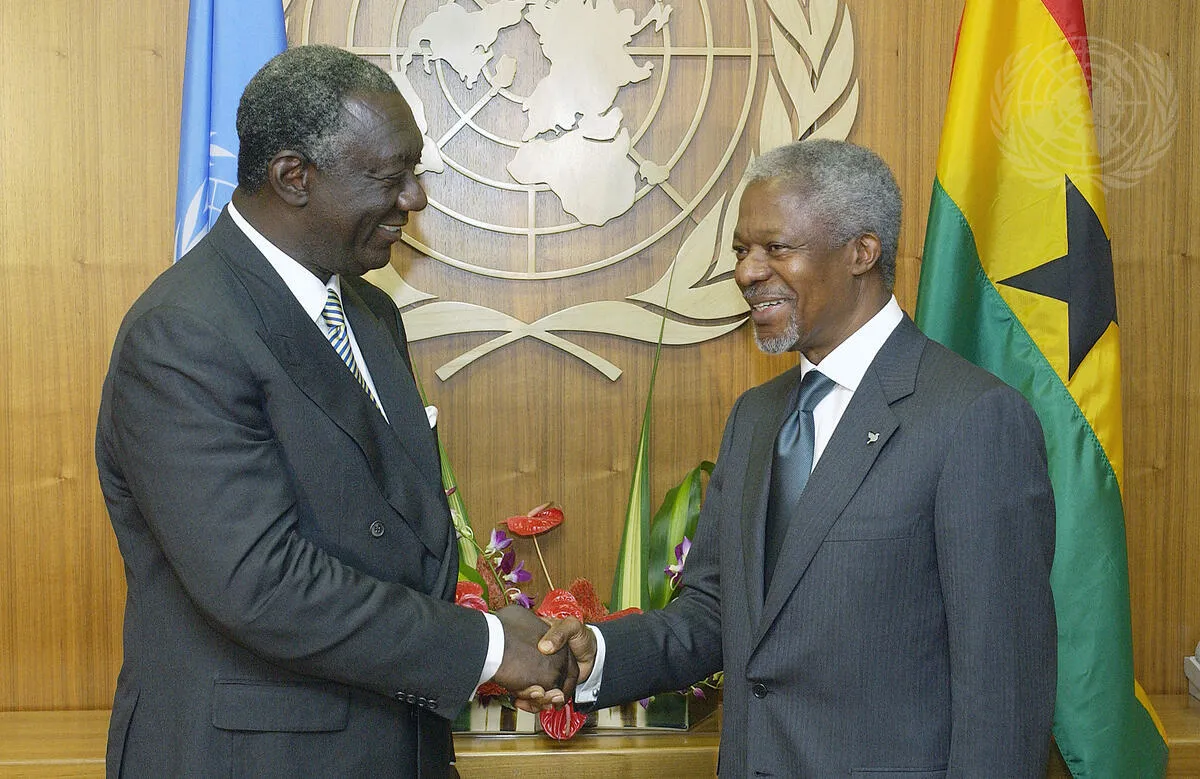
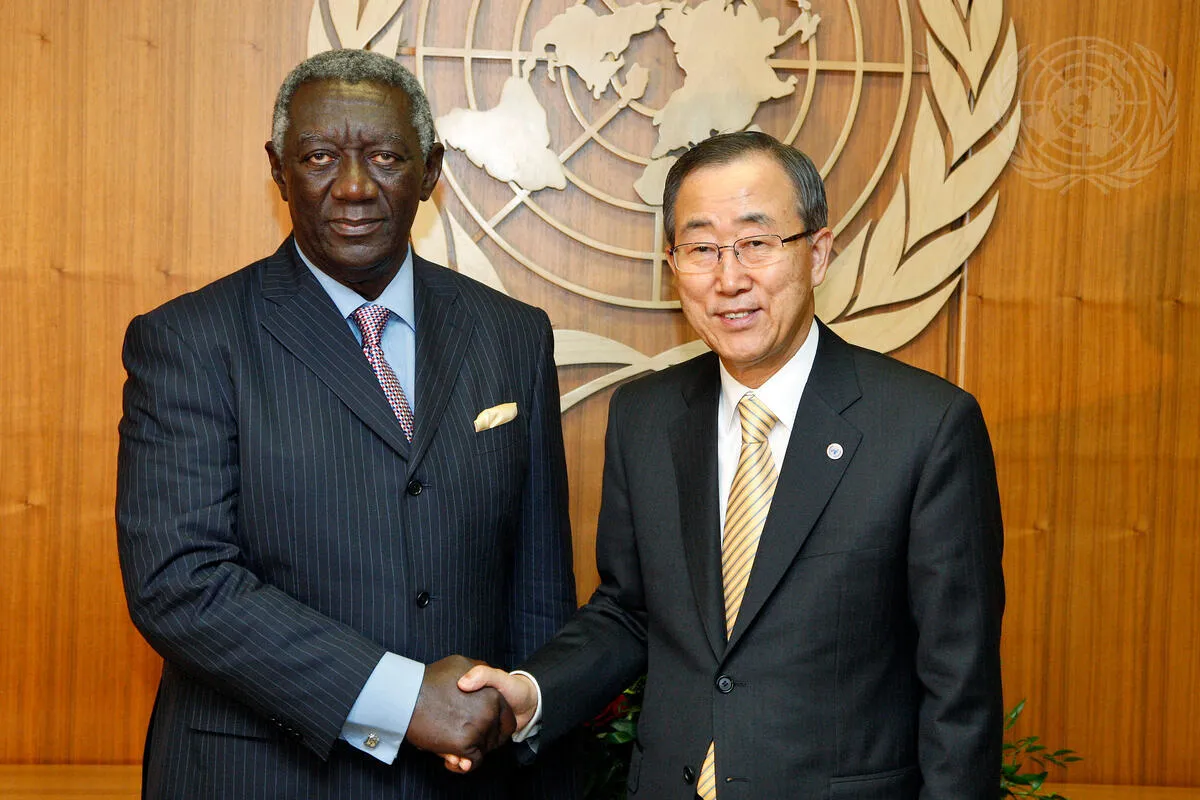
Under President Kufuor's leadership, Ghana's international standing was transformed. He was elected Chairman of the African Union for 2007–2008, using the platform to champion NEPAD, the African Peer Review Mechanism, and continental peace and security frameworks. He hosted the 9th AU Summit in Accra in July 2007, consolidating Ghana's position as a continent-wide convening power.
As ECOWAS chair, he was the principal mediator in Côte d'Ivoire's devastating post-election political crisis — personally shepherding the negotiations that produced the 2003 Linas-Marcoussis Accord and repeatedly returning to the mediation table when agreements faltered. He similarly led ECOWAS engagement in Liberia's post-conflict reconstruction and contributed diplomatically to efforts to end Sierra Leone's civil war.
His relationship with the United States was particularly fruitful. Ghana became one of the very first recipients of a Millennium Challenge Corporation compact — a $547 million agreement signed in 2006 — and hosted President George W. Bush for a landmark state visit in 2008 that underscored Ghana's status as America's preferred African democratic partner.
African Union Chairman 2007–2008; 9th AU Summit hosted in Accra, July 2007.
ECOWAS Chair; principal mediator in Côte d'Ivoire crisis (Linas-Marcoussis Accord, 2003).
Liberia and Sierra Leone post-conflict reconstruction led through ECOWAS framework.
Millennium Challenge Corporation Compact: $547 million (2006) — first in West Africa.
State visit by U.S. President George W. Bush to Ghana, February 2008.
Ghana@50 Golden Jubilee hosted 60+ heads of state and government, March 2007.
"We leave Ghana stronger, more prosperous, and more respected than we found it. That is the only measure of a president's success that ultimately matters."
— H.E. John Agyekum Kufuor, Final State of the Nation Address, 2009