Biography
Lawyer. Statesman. Democrat. Champion of African Development.
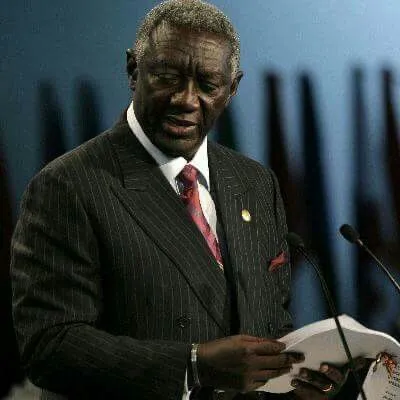
His Excellency John Agyekum Kufuor
His Excellency John Agyekum Kufuor is one of Africa's most celebrated democratic statesmen — a leader who proved that patient, principled governance could transform a nation. Over eight years as Ghana's 2nd President of the Fourth Republic, he guided his country through economic crisis into sustained prosperity, built institutions that have endured, and left a social legacy — in healthcare, education, and nutrition — that continues to shape the lives of millions.
Yet the full measure of John Kufuor cannot be taken by policy alone. He is a man of profound personal values: a devout Catholic, a committed family man, a constitutionalist who was imprisoned for his beliefs and emerged without bitterness. His willingness to relinquish power graciously after defeat at the ballot box in 2008 stands as perhaps his most eloquent act of statesmanship.
Since leaving office, he has continued to serve — through the John A. Kufuor Foundation, through international advisory boards, through lectures at the world's leading universities — carrying Ghana's story and Africa's case to the highest forums on earth.
Roots in the Ashanti Kingdom
John Agyekum Kufuor was born on 8 December 1938 in Kumasi — the historic capital of the Ashanti Kingdom and the second-largest city in Ghana. His family belonged to the Oyoko royal clan, the ruling dynasty of the Ashanti, and his father, Nana Kwadwo Agyekum, was a respected member of this distinguished lineage. His mother, Nana Ama Dapaah, equally prized education and community service.
Growing up in Kumasi during the final years of British colonial rule, Kufuor came of age at a moment of profound historical change. The independence movement was stirring across West Africa, and young Kufuor absorbed both the spirit of that transformation and the lessons of the Ashanti tradition — a tradition that prizes leadership by service, consensus-building, and communal responsibility above all else.
These twin inheritances — the Ashanti ethos of servant-leadership and the stirring promise of African self-determination — would become the philosophical bedrock of his later political life. He began his formal schooling at Government Boys Primary School in Kumasi and later attended Osei Tutu Methodist Boys' School before entering Prempeh College in 1954, one of Ghana's most prestigious secondary institutions.
"My upbringing in the Ashanti tradition taught me that leadership is not about power, but about service to the people. The values of respect, integrity, and community responsibility became the foundation of my approach to governance."— H.E. John Agyekum Kufuor
Oxford, Lincoln's Inn, and the Ghana Bar
Kufuor pursued his higher education at Exeter College, University of Oxford — one of England's oldest and most distinguished colleges — where he read Philosophy, Politics and Economics (PPE). The Oxford experience immersed him in the great debates of political philosophy, jurisprudence, and economic thought that would later inform his governing approach: his commitment to free markets tempered by social protection, his reverence for constitutional government, and his conviction that democratic institutions, once built, must be protected at all costs.
He subsequently trained for the English Bar at Lincoln's Inn — one of the four Inns of Court in London — and was Called to the Bar in 1961. Returning to Ghana, he was admitted to the Ghana Bar in 1962 and began his legal practice at Komfo Anokye Chambers in Kumasi, where he quickly earned a reputation for methodical legal reasoning and unimpeachable ethical conduct.
His legal training and Oxford education gave him tools he would wield throughout his career: a systematic approach to problem-solving, a deep respect for process and precedent, and an ability to build cross-party coalitions through patient dialogue rather than confrontation. These were not merely professional assets; they were the personal attributes of a man who genuinely believed that democracy works best when all players respect its rules.
"My education at Oxford opened my mind to different perspectives and taught me that true leadership requires both intellectual rigour and moral conviction. The law gave me the tools to serve justice."— H.E. John Agyekum Kufuor
From Local Government to National Leadership
Kufuor's entry into public service began at the local level. He served as Town Clerk (effectively Mayor) of Kumasi from 1967 to 1969, gaining essential hands-on experience in urban governance and public administration during the Busia transition government. This grounding in local governance — the practical reality of delivering services, managing budgets, and responding to citizens — would shape his entire approach to the presidency.
He was elected to Parliament as the Member for Atwima-Nwabiagya in 1969 under the Second Republic and was appointed Deputy Minister for Foreign Affairs (1969–1972) in the government of Prime Minister Kofi Abrefa Busia. This early diplomatic exposure — navigating the complexities of African regional politics and Ghana's relationships with Western donors and neighbouring states — prepared him for the continental leadership role he would later assume.
His political career was dramatically interrupted when General Acheampong's coup in January 1972 overthrew the Busia government and installed a military regime. Kufuor, a committed constitutionalist, opposed the coup and was subsequently imprisoned for approximately fifteen months — an experience that deepened rather than diminished his commitment to democratic governance. "I came out of that experience more determined than ever that the ballot box, not the barrel of a gun, must decide who governs Ghana," he has said.
He re-entered formal politics with Ghana's return to multi-party democracy. Elected again to Parliament in 1979 under the Third Republic, he served as Secretary for Local Government under the PNDC government (1984–1988) before ultimately joining the New Patriotic Party as democracy was restored in 1992. He was the NPP's presidential candidate in 1996, losing narrowly to incumbent President Jerry Rawlings but establishing himself as the credible, principled opposition leader Ghana needed.
"Politics is not about personal ambition; it is about serving the people and building a better future for our nation. Even in opposition, we must remain constructive and focused on the greater good of Ghana."— H.E. John Agyekum Kufuor, 1998
Two Terms, 2001–2009: Transforming Ghana
On 7 January 2001, John Agyekum Kufuor was inaugurated as Ghana's 2nd President of the Fourth Republic before jubilant crowds at the Black Star Square in Accra. The election he had just won — defeating NDC candidate John Evans Atta Mills in a run-off — had been the first in Ghana's history in which a sitting party lost power through the ballot box and accepted the result. It was a watershed moment for Ghanaian democracy, and the world took notice.
The economy he inherited was in severe distress: inflation above 40%, unsustainable external debt, foreign exchange reserves at critically low levels, and investor confidence near zero. His administration's most significant early decision — to enter the Heavily Indebted Poor Countries (HIPC) initiative — was politically contentious but economically transformative. The process was completed in 2004, delivering substantial debt relief and freeing fiscal space for the social investments that would define his legacy.
The economic record over eight years was remarkable: inflation from above 40% to below 10%; GDP growth averaging 6% per annum; the Ghana cedi stabilised; foreign direct investment multiplied; and the telecommunications revolution — triggered by market liberalisation — brought mobile connectivity to millions of previously unconnected Ghanaians. By the time he left office in 2009, Ghana's economic trajectory had been fundamentally altered.
But the achievements closest to his heart were social. The National Health Insurance Scheme (2003), the Capitation Grant abolishing basic school fees (2004), the National School Feeding Programme (2005), and the expansion of community health infrastructure across the country collectively transformed the daily lives of Ghana's poorest citizens. These were not abstract statistics but real changes in real lives: a mother in the Northern Region accessing antenatal care without paying cash; a child in a deprived community eating a hot meal at school for the first time; a rural family with electricity and running water for the first time.
"The presidency is not a prize to be won, but a sacred trust to be honoured. Every decision I made was guided by one simple question: How will this benefit the ordinary Ghanaian?"— H.E. John Agyekum Kufuor
Internationally, President Kufuor emerged as Africa's most respected democratic voice. He served as Chairman of the African Union (2007–2008) and ECOWAS chair, mediated the Côte d'Ivoire post-election crisis, supported Liberia's post-conflict reconstruction, and consistently championed NEPAD and the African Peer Review Mechanism. Ghana joined the APRM voluntarily in 2003 — among the very first African nations to do so — under his direct instruction.
The crowning act of his presidency came not with pomp but with restraint. Following his party's narrow defeat in the December 2008 elections, Kufuor accepted the result immediately, telephoned President-elect John Atta Mills to congratulate him, and conducted a gracious and orderly handover of power on 7 January 2009. In doing so, he gave Ghana — and Africa — a democratic example that the whole world could admire.
Continuing the Work
Since leaving office, President Kufuor has remained an active voice for African development, democratic governance, and humanitarian causes. In 2011 he established the John A. Kufuor Foundation, headquartered in Accra, with programmes spanning leadership development, health and nutrition advocacy, sustainable development, and governance reform across Africa.
He serves on multiple high-level international bodies, including as a member of the Prize Committee of the Mo Ibrahim Foundation for African Leadership, the Club de Madrid (former democratic heads of state), and as a WHO Goodwill Ambassador for Nutrition. He chairs the Global Commission on Evidence to Address Societal Challenges and has been appointed to advisory boards by the World Bank, the United Nations, and numerous bilateral development organisations.
He lectures regularly at leading universities — Oxford, Harvard, the London School of Economics — and has received over 20 honorary degrees from institutions across four continents. In 2011 he was awarded the World Food Prize, jointly with Brazilian President Lula da Silva, in recognition of his contributions to reducing hunger and malnutrition through Ghana's social protection programmes.
Personal Life
John Agyekum Kufuor is married to Theresa Kufuor (née Mensah), whom he has described as his greatest personal supporter and partner in public service. Mrs. Kufuor served with distinction as First Lady, championing maternal health, child welfare, and women's empowerment throughout his presidency. They have five children.
A devout Roman Catholic, Kufuor's faith has deeply shaped his public philosophy — his conviction that governance must be rooted in human dignity, his commitment to the poor and vulnerable, and his belief that political leaders are answerable to a higher moral authority beyond the electorate. He attends Mass regularly and has spoken movingly about the role of faith in sustaining him through the difficulties of political life.
"I have been privileged to serve Ghana and Africa in many capacities over many decades. But of all the things I have done, I am most proud that when I left office, Ghana was stronger, more hopeful, and more respected than when I arrived."— H.E. John Agyekum Kufuor